

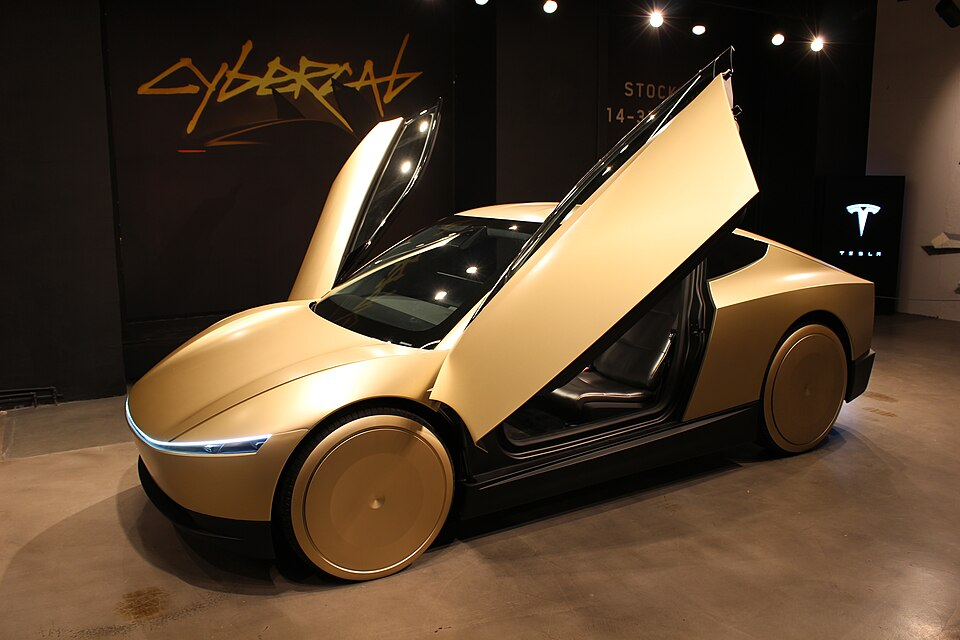
Tesla has released more details about its Cybercab, including restrictions for younger riders, its response to crashes, manual door releases, brake-by-wire technology and limits on its windows. The information followed a private Cybercab event that differed from Tesla’s usual large livestreamed launches, with a keynote that reportedly lasted about 15 minutes and no apparent presentation from CEO Elon Musk.
The Cybercab is designed as a fully autonomous two-seat vehicle without a steering wheel or pedals, using cameras and AI to drive. Tesla has promoted the vehicle as a lower-cost alternative to services such as Waymo, but the company now faces scrutiny over its safety as deployment begins.
The National Highway Traffic Safety Administration has already opened an investigation into the Cybercab rollout. Tesla has also published an official Cybercab Rider Guide covering how passengers interact with the vehicle.
Cybercab Sets Stricter Rules for Younger Riders
Tesla’s Robotaxi terms currently prohibit children under 13 from riding in a Cybercab. By comparison, children aged 8 to 17 can ride in Tesla’s Model Y Robotaxi vehicles, while passengers under 18 must be accompanied by an adult in both vehicles.
Tesla provides instructions for using child seats in both models, but the Cybercab does not include standard LATCH anchors. Child seats must instead be secured using the vehicle’s seat belts.
Crash Response and Vehicle Controls
If a Cybercab crashes, its airbags inflate and the doors unlock, while the hazard lights and interior lights turn on. The high-voltage battery is disabled, the windows move to a vent position, the vehicle applies its brakes and parks, and the infotainment system establishes a two-way connection with Tesla’s rider support team.
Automatic door unlocking is notable because Tesla has faced criticism over electronic door latches. The company recently agreed to recall 3 million vehicles in China alongside other automakers following an investigation into electronic latches that could make it difficult for occupants to exit after a crash.
Cybercab also uses electronic door latches during normal operation, allowing its doors to open automatically when a ride begins or ends. An exterior button can open the doors, while manual emergency releases are positioned on the interior armrests.
Tesla is also using a brake-by-wire system rather than conventional hydraulic brake lines. Electronic actuators control the brake calipers, with Musk saying the system avoids the plumbing required by hydraulic brakes; Tesla previously introduced steer-by-wire in the Cybertruck.
Other restrictions remain in the vehicle. Tesla’s documentation says the Cybercab’s windows cannot currently be fully opened, without explaining why.
The Cybercab also includes higher-powered USB-C ports. Influencer Jeremy Judkins reported that the ports provide 90 watts of power, roughly four times the output typically found in a vehicle.
Featured image credits: Wikimedia Commons
For more stories like it, click the +Follow button at the top of this page to follow us.