

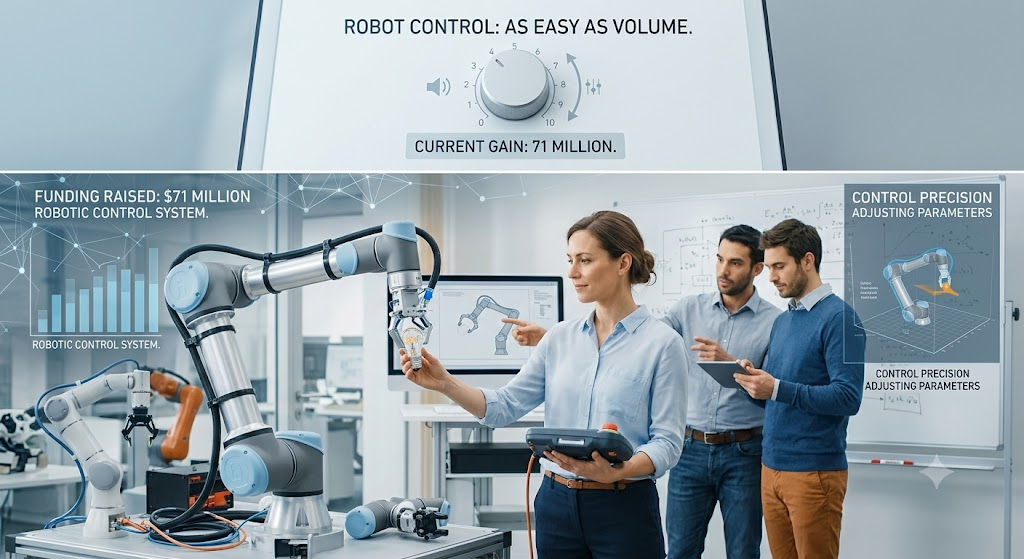
Enigma has raised $71 million in seed funding as it emerges from stealth with a different approach to robotics development. Rather than concentrating only on what robots can do, the research lab wants to understand how people naturally communicate with and control intelligent machines.
Index Ventures and Ribbit Capital led the funding round, with participation from Sarah Guo’s Conviction Partners. Enigma was founded less than a year ago by longtime friends Jonathan Jacobi and Gal Niv.
Public Experiment Opens Access to More Than 100 Robots
Enigma is launching an online experiment that will allow people around the world to interact remotely with more than 100 proprietary AI robots. The machines are housed in facilities in California and Israel and can complete tasks including painting pictures, moving laboratory flasks and competing in staged sword fights.
Participants will be able to communicate with the robots through different interfaces. Enigma plans to test whether people prefer using text, voice, video demonstrations or visual controls such as tapping, dragging and dropping.
The company said it developed both the robotic arms and their underlying AI models internally. Data collected from the experiment could influence its user interfaces and the way it trains future robotics foundation models.
Founders Focus on Effortless Robot Control
Jacobi said controlling a robot should eventually feel as natural as turning a car’s volume dial. A household robot would have limited value, he argued, if users had to spend more time explaining a task than completing it themselves.
Enigma’s approach differs from robotics companies that train models using internet videos, simulations, teleoperated machines or motion sensors worn by human workers. Its research begins with the experience of the person directing the robot rather than a predefined industrial capability.
Jacobi became Microsoft’s youngest employee after being recruited by Assaf Rappaport, who later co-founded cybersecurity company Wiz. He met Niv through teenage hacking competitions, and the pair later conducted cybersecurity research while serving in Israel’s Unit 8200.
Commercial Applications Remain Broad
Enigma has not disclosed a specific initial product or target market. Jacobi said the company is already working with organisations in healthcare, logistics and entertainment, although he did not identify the partners or projects.
The startup has assembled a team that includes former AI laboratory employees, mathematics competition participants and researchers who left doctoral programmes. Index Ventures partner Shardul Shah said the founders’ lack of traditional robotics experience allowed them to begin with questions about user experience that established robotics teams may overlook.
Featured image credits: Google Gemini
For more stories like it, click the +Follow button at the top of this page to follow us.