

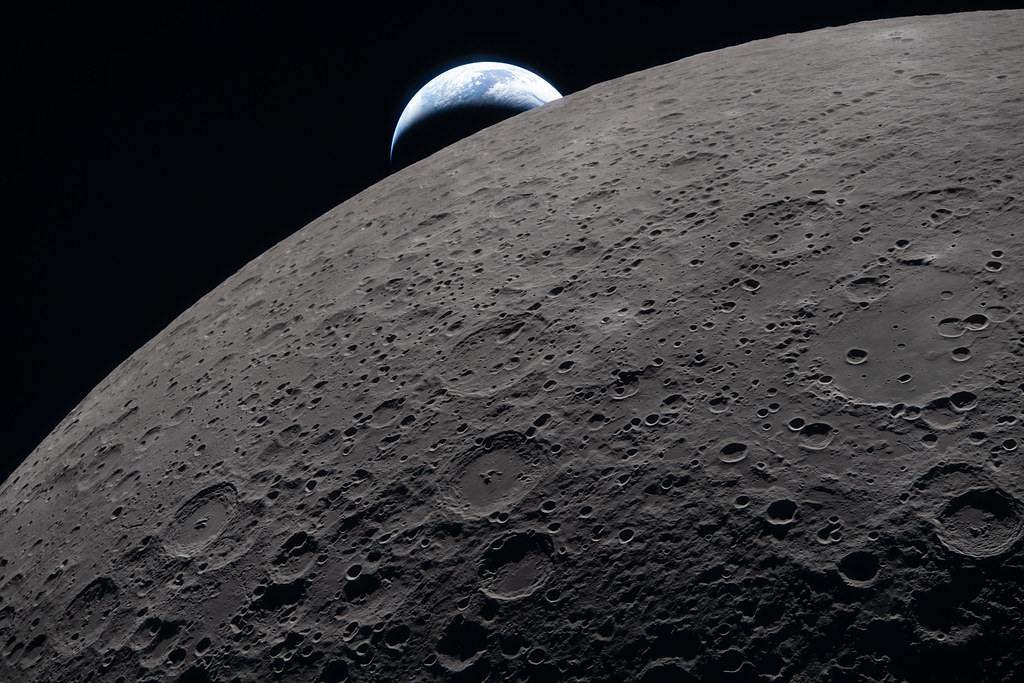
Companies are developing ways to extract helium-3 from the Moon as demand rises from quantum computing, scientific research, and possible nuclear fusion applications. The rare gas currently comes mainly from the decay of tritium used in nuclear weapons, leaving supply controlled and limited.
Helium-3 can cost about $2,000 per litre, although prices fluctuate. Lancaster University holds a valuable stockpile in metal beer kegs connected by copper pipes inside a secured laboratory, where researchers reuse the gas in low-temperature physics experiments.
Quantum Computers Depend on Helium-3 Cooling
Helium-3 is an isotope with one fewer neutron than helium-4, the more common gas used in balloons. When scientists mix both isotopes at extremely low temperatures, their separation produces a cooling effect that can reach the millikelvin range, close to minus 273C.
This dilution refrigeration process is important for many quantum computers because their components must operate near absolute zero. Helium-3 is also used in dark matter experiments and could serve as fuel in some future nuclear fusion reactors.
Tens of thousands of litres may be produced annually through tritium decay, according to David McCollum of Oak Ridge National Laboratory. Quantum computers alone could eventually require thousands of litres, depending on their design.
Interlune Develops Lunar Extraction Equipment
Seattle-based Interlune plans to recover helium-3 from lunar regolith using autonomous machines that excavate, crush, and process the Moon’s surface material. The company has about 30 employees and is led by former Blue Origin president Rob Meyerson.
Apollo 17 astronaut Harrison “Jack” Schmitt is also a co-founder and has supported lunar helium-3 extraction for decades. Interlune has tested equipment during parabolic flights and says some hardware could be integrated into a lunar lander by autumn 2027.
The company has signed a supply agreement with Finnish quantum computing equipment maker Bluefors. Under the agreement announced by Interlune, Bluefors could receive 10,000 litres annually between 2028 and 2037 in a deal valued at more than $300 million.
Significant technical questions remain. Apollo samples suggest lunar concentrations may range from a few parts per billion to more than 20 parts per billion, which could require processing hundreds of thousands of tonnes of regolith to obtain one kilogram.
Other Companies Pursue Lunar and Terrestrial Sources
Astrotech is also working on lunar resource systems and plans to study helium-3 extraction using heated regolith. The company expects its equipment to travel aboard a SpaceX Starship and has seven or eight people assigned to the project.
Researchers are also considering cooling methods that use less helium-3. Others are searching for deposits on Earth, where conventional drilling could be cheaper than transporting material from the Moon.
Pulsar Helium has reported helium-3 concentrations of up to 14.5 parts per billion at its Topaz Project in Minnesota. Peter Barry of Woods Hole Oceanographic Institution said terrestrial extraction remains an alternative because Minnesota is easier to reach than the Moon.
Featured image credits: NASA Johnson via Flickr
For more stories like it, click the +Follow button at the top of this page to follow us.