

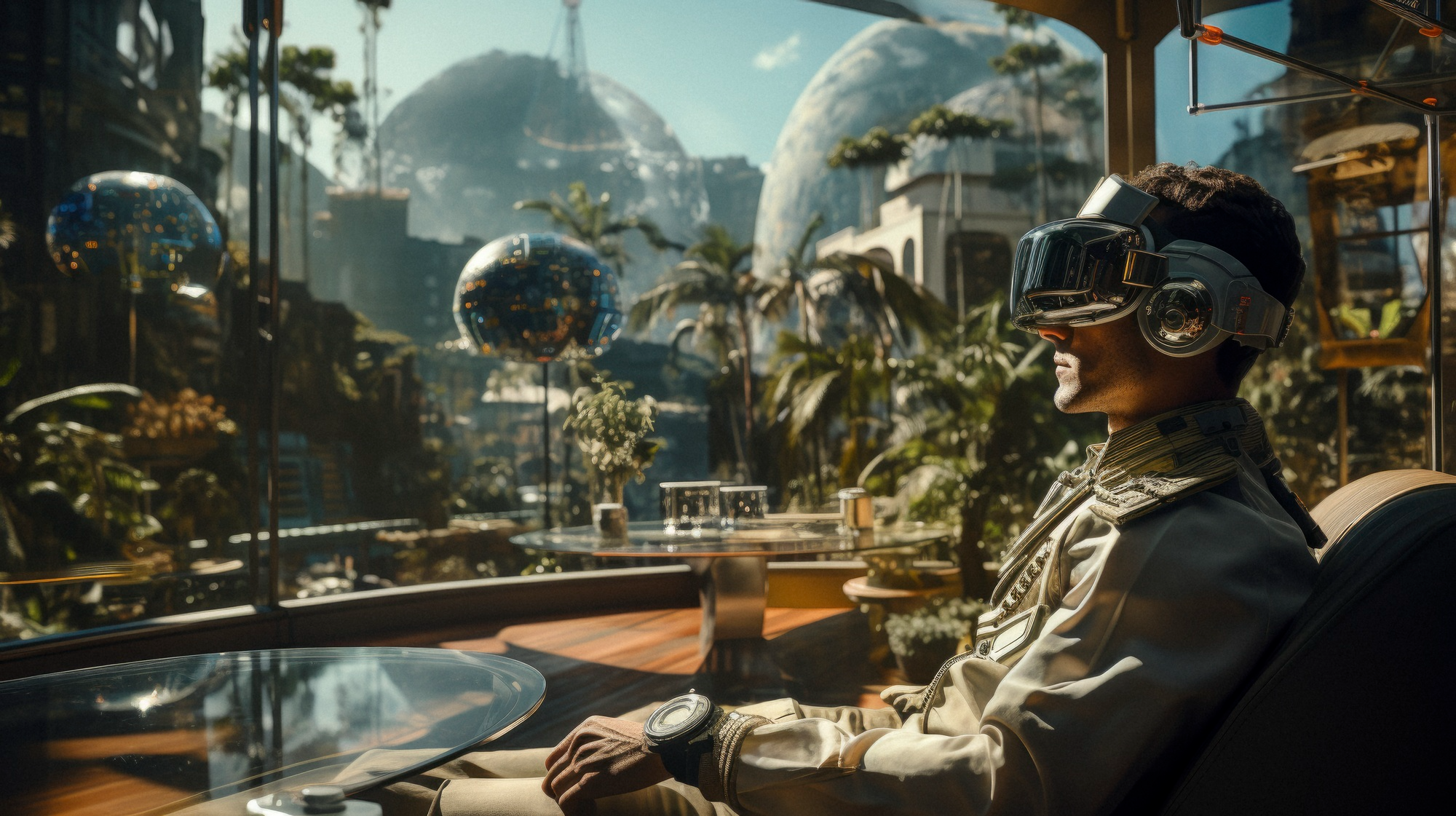
Experts say advances in nanotechnology, artificial intelligence, cybernetics, quantum computing, autonomous transport, and space manufacturing could reshape how people live, learn, travel, and receive medical care by 2050, according to forecasts shared with the BBC.
Twenty-five years ago, most people accessed the internet through dial-up connections, Netflix mailed DVDs, and smartphones were not part of daily life. By contrast, current developments in AI, robotics, and computing are progressing at a rapid pace. To assess what could come next, the BBC asked researchers, futurists, and writers to outline how technology might look by mid-century.
Nanotechnology And Human Enhancement
Science fiction has long imagined humans improving their physical and mental abilities through technology. In the 2000 video game Deus Ex, set in 2052, players use microscopic robots called nanites to gain abilities such as enhanced speed and night vision.
While such capabilities remain fictional, nanotechnology is already embedded in everyday devices. Modern computers and smartphones rely on chips made of billions of nanoscale transistors to process data efficiently.
Professor Steven Bramwell of the London Centre for Nanotechnology said that by 2050, distinctions between machines, electronics, and biology are likely to blur further. He told the BBC that nanotechnology implants could be used to monitor health or support communication rather than provide invisibility or extreme physical enhancements.
Bramwell also said medicine could increasingly use nanoscale machines to deliver drugs directly to targeted areas of the body.
Cybernetics And Medical Applications
Professor Kevin Warwick, a cybernetics researcher, has conducted experiments on himself, including implanting a microchip into his nervous system in 1998. He believes that by 2050, cybernetics could support new treatments for certain conditions.
Warwick said deep brain electronic stimulation could be used as a partial treatment for disorders such as schizophrenia, potentially reducing reliance on medication. He also said future enhancements may allow the brain and body to operate while physically separated.
Digital Twins And Personalised Health
Professor Roger Highfield, director of the Science Museum Group, said digital twins could become a routine part of life. These virtual replicas of physical objects are updated using real-time data.
Highfield said individuals could have thousands of simplified digital twins to test how medications, diets, or lifestyle changes might affect their bodies before making real-world decisions.
Quantum Computing And Artificial Intelligence
Technology firms including Google and IBM are investing billions in quantum computing, which aims to solve complex calculations at speeds beyond conventional computers. Such machines could simulate molecular interactions to accelerate drug development.
In January 2025, Jensen Huang, chief executive of Nvidia, said he expects quantum computing to become very useful within 20 years.
AI is also expected to influence education. Futurist and author Tracey Follows said learning could take place across physical and virtual settings using AI teachers that adapt in real time. She said immersive simulations may replace textbooks, while biometric or DNA data could help tailor education to individual students.
Transport And Automation
Writer Bill Douglass, who won a global futurist writing contest in 2000, said pilotless planes are still likely by 2050, though progress in autonomous cars may arrive sooner.
Douglass said driverless vehicles could reduce congestion by travelling closer together and braking simultaneously. On private toll roads designed for autonomous traffic, he said vehicles could reach speeds of around 100 miles per hour, with traffic fatalities falling sharply.
Space Manufacturing And Moon Bases
Journalist and Space Boffins podcast co-host Sue Nelson said space activity is expected to expand significantly. She said a liveable Moon base is likely within 25 years, and some industries may operate largely in space.
Nelson said pharmaceutical manufacturing could move into orbit, where microgravity conditions allow crystals to grow larger and with higher quality than on Earth.
Science Fiction And Cultural Influence
The 2002 film Minority Report, based on a novella by Philip K Dick, imagined life in the mid-2050s. Director Steven Spielberg consulted 15 experts, including virtual reality pioneer Jaron Lanier, to envision plausible future technologies.
The film depicted gesture-controlled displays, transparent screens, and advanced policing tools, presenting a pessimistic vision of technological oversight. Some contemporary experts have voiced similar concerns, including warnings that AI could pose existential risks.
Dick, however, offered a different perspective in his 1968 autobiographical essay Self Portrait, writing that science has given humanity more lives than it has taken.
Featured image credits: Freepik
For more stories like it, click the +Follow button at the top of this page to follow us.