

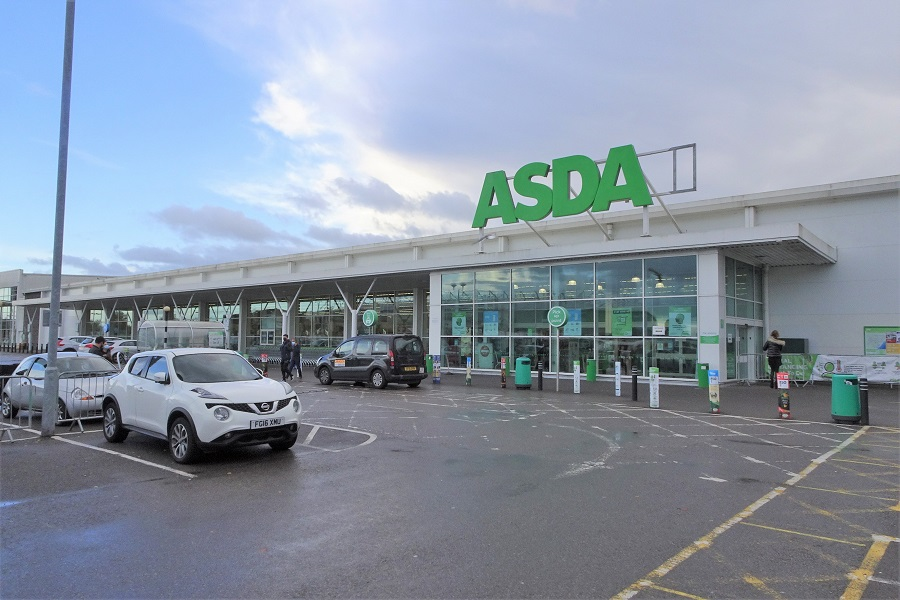
Asda is losing customers and market share despite lowering prices and reviving historic pricing campaigns, with industry data showing continued sales declines, mounting debt pressure, and limited evidence that its turnaround strategy is changing shopper behaviour.
Shoppers Still Visit, But Data Shows Decline
For some local customers, the appeal remains. Carol Stimpson, who lives near an Asda store in Crawley, says it is only a ten-minute walk from her home and that she visits almost every day, treating it as her corner shop. Joanne Dench, also shopping in Crawley, says she values the variety on offer, including clothing and international food.
These experiences contrast with the wider performance of Asda, the UK’s third-largest supermarket. According to Worldpanel, Asda’s sales fell by 4.2% in the 12 weeks to 28 December 2025, following a weak Christmas the year before. Over the same period, all major rivals reported growth. William Woods, a food retail analyst at Bernstein Research, describes Asda’s position as “a mess,” pointing to continued customer defection despite price reductions.
From Cheapest Grocer To Losing Ground
For decades, Asda was known as Britain’s cheapest grocer, supported by its long-running “That’s Asda Price” advertising campaign, first aired in 1977. In 1999, the supermarket was sold to Walmart in what was then the largest foreign takeover in UK retail.
From around 2010, Asda began to struggle as discounters Aldi and Lidl expanded rapidly, while Walmart focused more heavily on its US operations. In 2021, Walmart sold Asda after receiving just over £4bn in dividends over the previous four years.
Debt-Funded Takeover And Operational Disruption
Asda was acquired for £6.8bn by billionaire brothers Mohsin and Zuber Issa, founders of EG Group, alongside private equity firm TDR Capital. The transaction was largely debt-funded, making it one of the UK’s biggest leveraged retail takeovers.
The deal was completed during a pandemic-driven grocery boom. Market conditions shifted soon after, as inflation surged following the war in Ukraine and interest rates rose, increasing borrowing costs. After the takeover, Asda’s chief executive left and Mohsin Issa assumed control. A former senior executive says his instincts were sound, but the business lacked experienced leadership during a volatile period.
High management turnover followed, priorities changed, and store standards declined. Customers complained about empty shelves, slow restocking, and reduced online availability after staff hours were cut. Lynette, a shopper from Swindon who had used Asda for more than 20 years, says the deterioration was visible, with closed tills and poor stock levels. She has since shifted most of her shopping to Aldi and Lidl.
At the same time, Asda was carrying out a major technology transition, moving away from Walmart’s systems. This included installing around 16,500 new checkouts and launching a new groceries app and website, at a cost of hundreds of millions of pounds.
Falling Market Share And Revenue Impact
By autumn 2024, Mohsin Issa stepped down from his executive role, and TDR Capital took majority ownership. Worldpanel data shows Asda’s market share fell from 14.3% before the takeover to 11.4% by the end of December 2025. Based on current grocery prices, Worldpanel sales analysis indicates this represents around £4.5bn less in annual revenue than if Asda had maintained its earlier share.
Woods notes that supermarkets operate with high fixed costs and thin margins, meaning falling volumes can quickly lead to a negative cycle that is difficult to reverse.
Rollback Pricing Returns Under New Leadership
In November 2024, Asda appointed Allan Leighton, then aged 71, as executive chair. Leighton previously helped stabilise Asda in the 1990s and has revived the “Asda Rollback” pricing campaign. Under the current model, temporary price cuts are followed by permanent reductions under a new “Asda Price” label.
Leighton has said his goal is to make Asda 5–10% cheaper than other traditional supermarkets by the end of 2026, even if that requires a short-term hit to profits. Pricing data suggests some progress. Retail research firm Assosia told the BBC that Asda’s prices on more than 30 branded items were mostly lower than Tesco, Sainsbury’s, and Morrisons during the festive quarter, based on promotions.
Asda has also frequently topped the weekly price survey run by The Grocer, which excludes Aldi and Lidl. Adam Leyland, editor-in-chief of the publication, says that at times Asda has been about 5% cheaper than its established rivals.
Price Gains Fail To Bring Back Customers
Despite improved pricing, sales data shows no sustained recovery in customer numbers. Leyland says shopping decisions are influenced by more than price, citing store standards, range, service, and brand perception. Madeline, a Crawley resident, says she avoids doing her main shop at Asda due to empty shelves and obstructed aisles during restocking.
A major supplier says Asda needs to invest more in availability and basic retail execution. Asda says it has increased staffing levels and insists progress is being made. However, Worldpanel data shows the retailer recorded its 22nd consecutive month of declining sales in December.
Woods argues Asda should have continued its Aldi and Lidl price match campaign, which ended in January 2025. He says price matching has helped Tesco and Sainsbury’s reshape customer perception, particularly when combined with loyalty schemes such as Clubcard and Nectar.
Debt Pressure And Investor Concerns
Asda says rebuilding the business will take three to five years. A spokesperson says the company is in the early stages of its transformation, focused on value, availability, and customer experience, and that stronger volumes have appeared in recent periods.
Another person familiar with the business says signs of recovery last summer were disrupted by the final phase of separating from Walmart’s systems, which led to stock shortages ahead of Christmas and delayed progress by about six months.
Debt remains a major constraint. To reduce borrowings, Asda has sold and leased back stores and a distribution centre. At the end of December 2024, its net debt stood at £3.8bn, while annual financing costs rose 38% to £611m. Asda says its balance sheet and free cash flow are sufficient to meet current and future obligations.
Former Asda buyer Ged Futter says he believes the retailer is in serious difficulty, citing suppliers walking away from funding promotions. The price of Asda’s traded debt has also fallen further this year, indicating growing investor concern.
Remaining Strengths And Uncertain Outlook
People familiar with the business say Asda retains strengths in its in-store pharmacies, opticians, the George clothing line, and its general merchandise operation. Comparisons are often drawn with Morrisons, which has also struggled under private equity ownership but has recently stabilised after selling assets to cut debt.
Some industry observers expect structural changes across the sector, including break-ups, sales, or mergers. Leighton has compared the task of restoring Asda to climbing Mount Everest. For shoppers like Lynette in Swindon, however, the relationship appears permanently changed. She says she may still visit occasionally but does not expect to return as a regular customer.
Featured image credits: Wikimedia Commons
For more stories like it, click the +Follow button at the top of this page to follow us.