

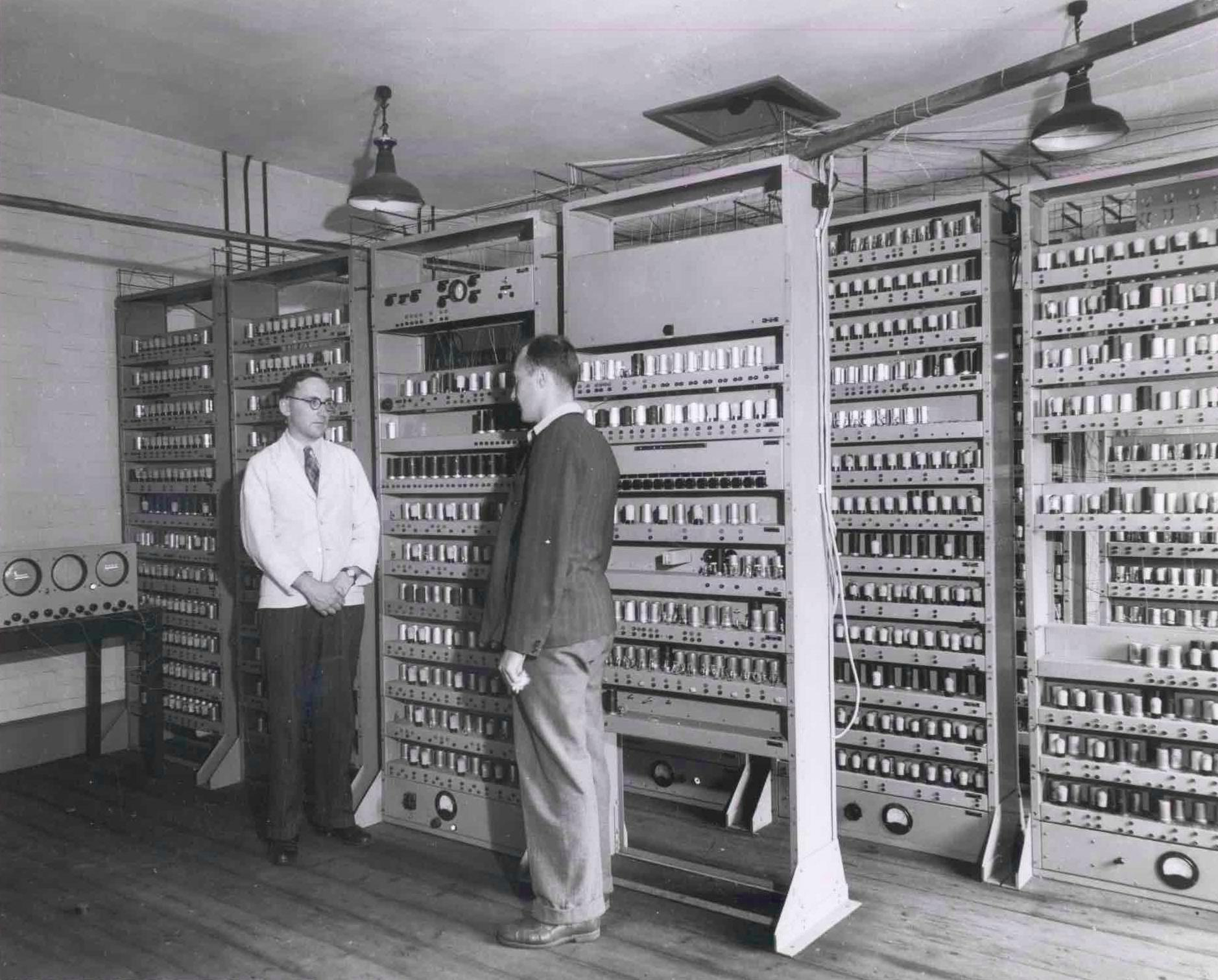
A blue plaque has been unveiled in Cambridge to commemorate EDSAC, an early computer that helped establish principles still used in modern computing.
The Electronic Delay Storage Automatic Calculator was the first computer built at the University of Cambridge. It ran its first program on May 6, 1949, and became the first practical stored-program computer to provide a regular computing service.
EDSAC Stored Instructions and Data Together
EDSAC could hold a program’s instructions and the data being processed within the same electronic memory. This stored-program design remains a basic feature of modern computers, from smartphones and laptops to data-centre servers.
The University of Cambridge said EDSAC was thousands of times faster than the mechanical calculators available at the time. It enabled researchers to complete scientific calculations that had previously required substantial time or were considered impractical.
The machine was not Britain’s first stored-program computer. The experimental Manchester Baby had run a program 11 months earlier, but EDSAC was designed to provide a dependable computing service for researchers rather than serve mainly as a technical experiment.
EDSAC weighed approximately two tonnes and occupied an entire room at Cambridge’s Mathematical Laboratory. It used vacuum tubes for logic, mercury delay lines for memory, punched paper tape for input and a teleprinter for output.
Maurice Wilkes Led the Development Team
Computer scientist Maurice Wilkes led the team that designed and built EDSAC after returning to Cambridge following his wartime work on radar. Development began in 1946, shortly after Wilkes attended lectures on electronic computing at the University of Pennsylvania.
The machine remained in use until 1958 and supported research in subjects including genetics, chemistry, meteorology, radio astronomy and X-ray crystallography. Calculations performed with EDSAC contributed to work later recognised with several Nobel Prizes.
Cambridge researchers also developed early programming techniques around the machine, including reusable subroutines and organised libraries of code. Wilkes later received the ACM Turing Award for his contributions to computing.
Plaque Will Mark EDSAC’s Original Location
The Cambridge Blue Plaque Scheme, operated by civic charity Cambridge Past, Present & Future, recognises people and events that have made a lasting contribution to the city.
The plaque was unveiled at Cambridge’s Department of Computer Science and Technology. It will later be installed on the David Attenborough Building, located where the Mathematical Laboratory stood when EDSAC was created.
Department head Professor Alastair Beresford said both the machine and the research it supported had a lasting influence. Its stored-program architecture and role as a shared computing service helped move electronic computing from experimentation into practical academic use.
Featured image credits: Wikimedia Commons
For more stories like it, click the +Follow button at the top of this page to follow us.