

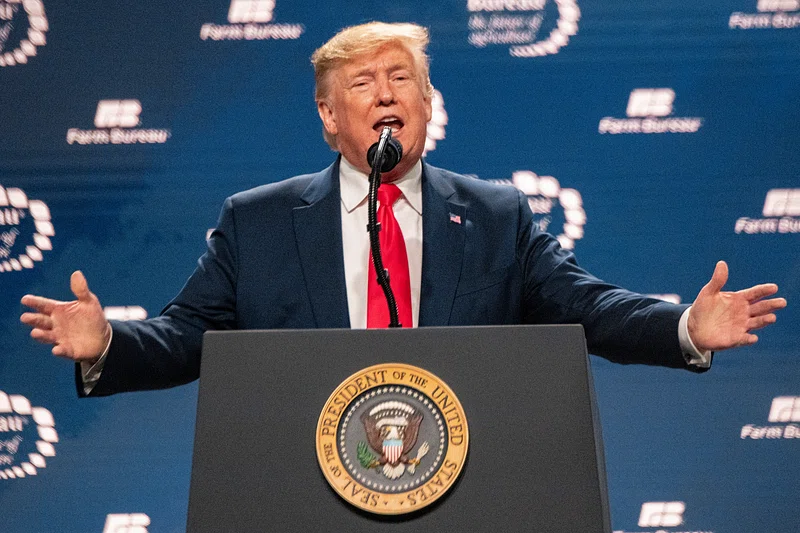
President Donald Trump’s tariffs have become a defining feature of his second term, with the US administration arguing they are supporting jobs, wages, and growth, even as international institutions and economists point to slower global expansion and rising uncertainty tied to their continued use.
In his pre-Christmas address to the nation, Trump again highlighted tariffs as a central policy tool. While the benefits he cited remain disputed, their effect on global trade patterns, investment decisions, and economic forecasts is clearer, with those effects expected to carry into 2026.
Global Growth Forecasts Revised Lower
International Monetary Fund said the tariff impact is a key reason it now expects global economic growth to slow to 3.1% in 2026. A year earlier, the IMF had forecast growth of 3.3% for this year.
IMF managing director Kristalina Georgieva said recent outcomes were “better than we feared, worse than it needs to be,” noting that global growth has dropped from a pre-Covid average of 3.7%. She said the current pace is not fast enough to meet public expectations for improved living standards.
Other forecasts for 2026 are more pessimistic. Maurice Obstfeld, a senior fellow at the Peterson Institute for International Economics and former IMF chief economist, said the economic impact could have been more severe had countries responded more aggressively to US tariffs.
Limited Retaliation And US China Tensions
Obstfeld said most countries did not retaliate strongly against the US. China, which did respond forcefully, prompted a quick US pullback, helping avoid what he described as a trade disaster.
Even so, after five rounds of trade talks, the US and China still have more tariffs and trade restrictions in place than when Trump began his second term. The latest available data shows the value of goods traded between the two countries fell for a third consecutive year in 2025.
Tariffs have increased costs for businesses and added uncertainty, complicating long-term planning and investment. Obstfeld said that while the global economy has shown resilience, these frictions reduce efficiency over time.
Offsets And Trade Resilience
Some tariff-related damage has been offset by lower interest rates, a weaker dollar, business workarounds, and numerous exemptions. This helps explain why the UN trade agency UNCTAD expects global trade value to have risen 7% last year to more than $35 trillion.
Obstfeld described exemptions as a mixed factor. They lower tariffs in practice, but they also create uncertainty around eligibility and access, which affects business decisions.
Countries such as the UK, South Korea, and Japan have negotiated trade agreements with the US. Others are expected to seek similar arrangements during 2026.
US Growth And Inflation Pressures
Despite doubts among some economists, the US economy grew at an annual rate of 4.3% between July and September, its strongest pace in two years. Aditya Bhave, a senior economist at Bank of America, said the US economy has shown strong resilience and expects that trend to continue.
Bhave estimated tariffs have added between 0.3% and 0.5% to US inflation. Inflation stood at 2.7% in November, and he said the full impact may not yet be visible. The US accounts for 26% of global economic output, according to IMF data, and is heavily driven by consumer spending.
In the eurozone, inflation has stabilised at 2.1%. In the UK, it remains higher at 3.2%, above the 2% targets set by central banks in both regions.
Trade Deals And Legal Uncertainty
Other developments expected to influence the global economy in 2026 include the renegotiation of the US Mexico Canada Agreement, which Trump signed during his first term. EU member states are also set to vote on whether to ratify a South American trade deal agreed more than a year ago.
In the US, uncertainty remains around a Supreme Court ruling on the legality of Trump’s tariffs, a decision that could shape future trade policy.
Energy Prices And Shipping Routes
Oil remains a critical input for the global economy. Goldman Sachs expects benchmark Brent crude prices to fall about 8% this year to around $56 a barrel, driven by strong production in the US and Russia. Trump’s actions toward Venezuela are not expected to increase global oil supply in the short term.
Another potential source of downward pressure on prices is shipping. A week before Christmas, Maersk sent a container ship through the Red Sea for the first time in nearly two years. Attacks by Houthi rebels linked to the Gaza conflict had forced most shipping firms to reroute vessels around southern Africa.
Maersk said the voyage marked progress but added that it was not yet ready to commit to a wider return to the trans-Suez corridor.
China’s Role And Ongoing Talks
China remains a major destination for container shipping and a central player in global trade. However, tensions with the US continue to weigh on the outlook.
President Xi Jinping did not address trade strains or domestic economic challenges in his 2026 New Year message. He said China is expected to reach an economic size of $20 trillion this year and is prepared to work with other countries on global development.
Tariffs, rare earth sourcing, and access to advanced US computer chips have dominated recent US China discussions. James Zimmerman, chair of the American Chamber of Commerce in China, said expectations for progress remain low ahead of Trump’s planned visit to China in April, but added that sustained dialogue remains important.
Zimmerman said Beijing seeks fairer conditions to compete globally, while US concerns include how China manages manufacturing output and overcapacity. He said China needs to adjust production when demand falls to avoid large-scale dumping of consumer goods.
Europe And US Manufacturing Policy
In Europe, reliance on low-cost Chinese imports is increasing, according to research from ING. The EU is expected to take steps in the coming months to address this trend.
In the US, limiting imports remains a central goal of Trump’s trade policy. US Trade Representative Jamieson Greer recently wrote that increasing manufacturing’s share of the economy serves national interests and said investment in domestic production of vehicles, ships, and pharmaceuticals would not be occurring without tariffs.
Despite this, US manufacturing employment has edged down slightly since Trump’s second term began, falling to just under 12.7 million jobs.
Obstfeld said continued growth has been supported by consumer spending and heavy investment in artificial intelligence, which has driven stock markets to record highs. With key policy goals, such as expanding manufacturing employment, still unmet, he said tariffs are likely to remain part of US policy discussions.
Featured image credits: U.S. Department of Agriculture via rawpixel
For more stories like it, click the +Follow button at the top of this page to follow us.