

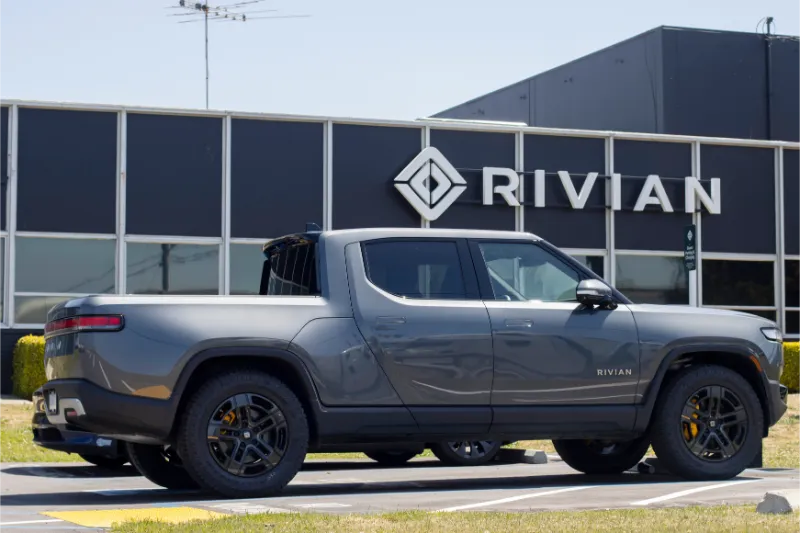
Rivian has reduced its planned loan from the U.S. Department of Energy to $4.5 billion while increasing the initial production capacity of its Georgia factory, signaling adjustments to its expansion and cost strategy.
Loan Adjustment And Earlier Draw Timeline Announced
The revised loan amount is down from the previously allocated $6.6 billion. Rivian said it now plans to begin drawing on the loan in early 2027, earlier than initially expected, to support construction and scaling of the facility.
Factory Capacity Increased In Initial Phase
The company raised the initial production capacity of the Georgia plant from 200,000 to 300,000 vehicles, a 50% increase. Rivian said the higher output is intended to reduce per-unit costs and provide room for future expansion.
The company previously outlined a total site capacity of 400,000 vehicles across two phases. CFO Claire McDonough said the first phase will occupy the upper portion of the site, while the lower section remains reserved for future development. She did not provide updated figures for the second phase.
Overall Production Capacity Target Adjusted
Rivian said the loan supports scaling total production capacity to 515,000 vehicles across its facilities, lower than earlier projections. Its existing plant in Normal, Illinois has a capacity of 215,000 vehicles.
Uber Partnership Includes Robotaxi Production Plans
Part of the Georgia plant’s capacity will be used to produce R2 robotaxis for Uber. Under an agreement announced earlier, Uber will invest an initial $300 million in Rivian and plans to purchase 10,000 autonomous R2 vehicles for deployment in cities including San Francisco and Miami in 2028.
The agreement includes an additional $250 million investment later this year, with potential total investment reaching $1.25 billion through 2031 if milestones are met. Uber also has the option to purchase up to 40,000 additional vehicles starting in 2030.
Construction Progress And Production Timeline
Rivian began construction on the Georgia facility last year and is currently in early stages of vertical construction near Atlanta. The company expects production at the site to begin by the end of 2028.
In the interim, R2 vehicles are being produced at the Illinois facility. Rivian said it has begun initial deliveries to employees, with broader customer deliveries expected in the coming weeks.
Financial Results Show Revenue Growth And Continued Losses
Rivian reported first-quarter 2026 revenue of $1.38 billion, including $908 million from vehicle sales and $473 million from software and services. Automotive revenue declined about 2% year over year, partly due to lower regulatory credit sales.
The company reported a net loss of $416 million, an improvement from a $541 million loss in the same period last year. The reduction was partly attributed to a $506 million gain related to a Series A capital raise and the deconsolidation of CEO RJ Scaringe’s startup, Mind Robotics.
Rising Costs And Cash Flow Pressures Continue
Operating expenses and research and development costs increased year over year. R&D spending rose 20% to $458 million, driven by R2 pre-production and investments in software and autonomous vehicle development.
Rivian reported negative free cash flow of $1 billion for the quarter, nearly double the level from a year earlier, reflecting higher costs and increased capital spending.
Featured image credits: Epoch Automotive
For more stories like it, click the +Follow button at the top of this page to follow us.