

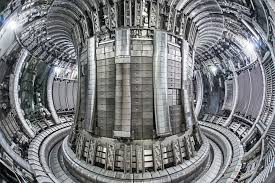
Fusion startup Inertia Enterprises has signed three agreements with Lawrence Livermore National Laboratory to commercialize laser-based fusion technology, building on experiments conducted at the lab’s National Ignition Facility. The partnerships aim to translate controlled fusion breakthroughs into scalable power generation.
Foundation In Proven Fusion Experiments
The National Ignition Facility remains the only experiment to demonstrate controlled fusion reactions that produce more energy than required to initiate them. Inertia, which raised $450 million in a Series A round earlier this year, is positioning itself to build on that milestone as it develops commercial applications.
The company’s approach focuses on inertial confinement fusion, a method that compresses fuel using external forces rather than magnetic confinement systems used by other fusion efforts.
How The Laser Fusion Process Works
At the National Ignition Facility, 192 laser beams are directed into a vacuum chamber, converging on a small gold cylinder known as a hohlraum. When struck by the lasers, the cylinder emits X-rays that compress a diamond-coated fuel pellet containing deuterium and tritium.
The outer layer of the pellet becomes plasma, which expands inward and compresses the fuel to conditions necessary for fusion. For commercial energy production, this process would need to occur multiple times per second.
Technical Origins And Development Timeline
Laser-driven fusion concepts were first explored in the 1960s, initially as a method for studying thermonuclear reactions. Construction of the National Ignition Facility began in 1997, and it took 25 years to reach the point where fusion reactions achieved net energy gain.
Several companies, including Xcimer Energy, Focused Energy, and First Light Fusion, are working to adapt similar approaches for commercial power plants.
Partnership Scope And Technology Development
The agreements between Inertia and Lawrence Livermore include two strategic partnership projects and a cooperative research and development agreement. The collaboration will focus on developing more efficient laser systems and improving fuel targets to enhance performance and manufacturability.
Inertia is also licensing nearly 200 patents from the laboratory, providing access to a significant body of intellectual property related to fusion technology.
Leadership And Policy Context
Annie Kritcher, co-founder and chief scientist of Inertia, previously contributed to the National Ignition Facility experiment that achieved scientific breakeven. Her ability to lead a startup while maintaining a role at the laboratory was enabled by provisions in the CHIPS and Science Act passed in 2022.
Featured image credits: Instagram
For more stories like it, click the +Follow button at the top of this page to follow us.