

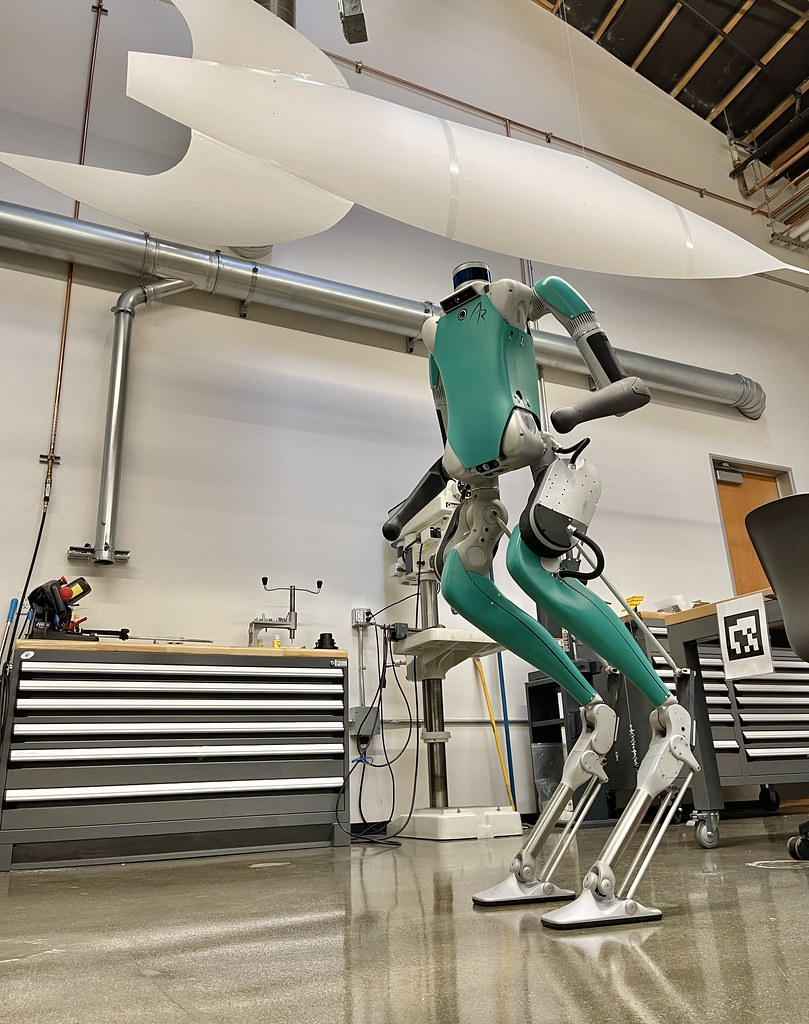
Agility Robotics plans to go public through a merger with Churchill Capital Corp XI, a special purpose acquisition company backed by Michael Klein. The deal values the Oregon-based humanoid robotics company at about $2.5 billion and is expected to raise more than $620 million in gross proceeds.
The merger still requires shareholder approval and regulatory review. If completed later this year, Agility would become the first pure-play humanoid robotics company to trade on public markets.
Agility was founded in 2015 as a spinout from Oregon State University. Its main product, Digit, is a bipedal humanoid robot designed to move goods in warehouses, factories and logistics facilities.
Digit Targets Warehouse and Factory Work
Digit stands about 5 feet 9 inches tall and weighs roughly 160 pounds. Its reverse-bend legs allow it to reach low and high storage areas without colliding with warehouse racks, while its hands are designed to grip and carry heavy plastic totes.
Chief executive Peggy Johnson said Agility’s focus remains on industrial environments rather than homes. Warehouses and factories have structured layouts, predictable workflows and immediate labour shortages, while homes are harder to automate because they contain pets, children, visitors and changing objects.
The company says customers already include GXO Logistics, Amazon, Toyota Motor Manufacturing Canada, Schaeffler and Mercado Libre. Agility has more than $300 million in booked, multi-year revenue linked to about 1,000 robots under its robots-as-a-service model.
Under that model, customers pay a recurring fee instead of buying the robots outright. Johnson said the proceeds from the SPAC deal would support production at Agility’s 70,000-square-foot facility in Salem, Oregon, and help fulfil existing orders.
Humanoid Robotics Attracts Heavy Funding
Agility’s listing plan comes during a surge of investment in humanoid robotics. Apptronik has raised more than $935 million in Series A funding, while Figure AI said last year that it raised $1 billion at a $39 billion valuation.
AI2 Robotics, a Shenzhen-based company making wheeled humanoid robots, also recently raised about $735 million at a valuation close to $3 billion. Compared with those private-market valuations, Agility’s planned public listing is more measured.
Johnson said the SPAC route gives Agility faster access to public capital while the company still has a first-mover position. She also acknowledged the poor record of many earlier SPAC listings but said Agility’s focus is on execution, customer deployments and adding new robot skills.
Safety Remains a Key Differentiator
Agility uses large language models including Claude and Gemini for the semantic layer of its system, which helps translate higher-level instructions into robot actions. Johnson said the company remains model-agnostic and sees its core advantage in the physical layer: balance, movement, manipulation and real-world operating data.
She also said safety is one of Agility’s most important differences from competitors. The company must meet industrial safety requirements before deploying robots inside customer facilities.
Johnson argued that safety has to be designed into the robot from the start, including its electrical systems, parts and software. She said Agility’s decade of work in physical robotics gives it experience that cannot be replicated through software alone.
Featured image credits: Steve Jurvetson via Flickr
For more stories like it, click the +Follow button at the top of this page to follow us.