

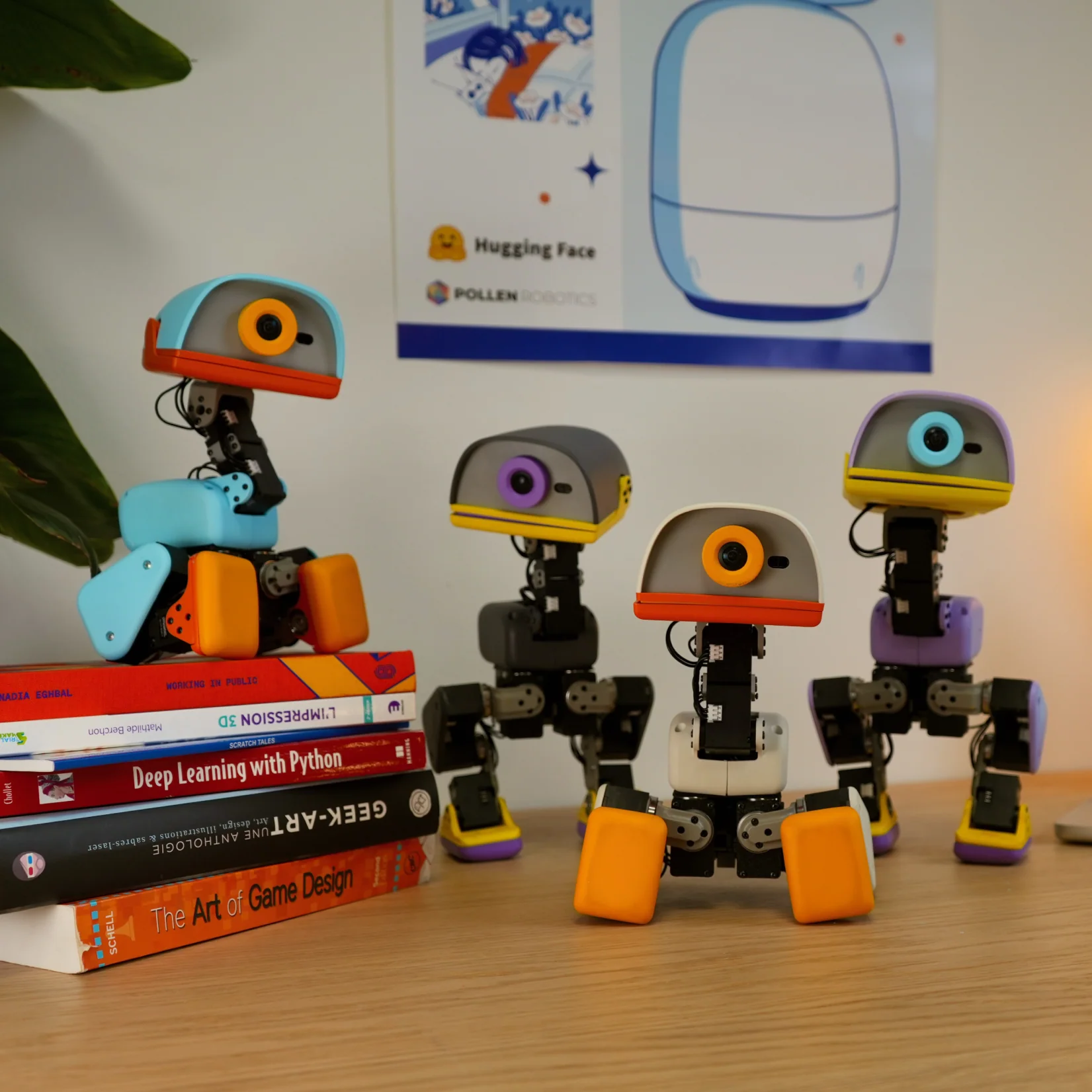
Hugging Face and Pollen Robotics have introduced Microduck, a 25-centimeter-tall open-source biped robot designed to let developers train new physical behaviors with reinforcement learning. The robot costs $399 before taxes and shipping, with preorders open now and initial deliveries targeted before Christmas 2026.
Microduck can waddle, crouch, sit, roller skate, recover after falling, and pick up objects weighing as much as 800 grams with its beak. Pollen Robotics says seven trained movements are included out of the box.
Microduck Is Built for Reinforcement Learning
According to Pollen Robotics’ official announcement, developers can train behaviors in simulation and then deploy them directly to the physical robot. They can subsequently fine-tune, retrain, and redeploy those behaviors as they experiment with different tasks.
The robot includes 15 motors and perceives its surroundings through a camera, LiDAR, and two inertial measurement units. Its onboard control system runs policies at 50Hz, while the software development kit, simulation environment, robot control tools, and reinforcement-learning training stack are open source.
Hugging Face CEO Clem Delangue described Microduck as an open-source robot that users can teach new behaviors through reinforcement learning. The company positions the device as a lower-cost way for developers to experiment with physical AI and models that interact with real-world environments.
Microduck Extends Hugging Face’s Robotics Push
Hugging Face expanded further into robotics after acquiring French robotics company Pollen Robotics in April 2025. The companies later introduced Reachy Mini, a small desktop robot aimed at developers building and testing AI applications on physical hardware.
Pollen said in its Microduck product page that the new robot complements Reachy Mini by focusing on movement through physical environments rather than primarily staying on a desk and interacting with users. More than 10,000 Reachy Mini units have been distributed since that product launched, according to Pollen Robotics.
Open-source software gives developers access to inspect and modify the systems running the robot, although that alone does not ensure that data captured by its sensors remains private. Applications installed on the robot could still access camera or other sensor data and transmit information elsewhere depending on how they are built.
The Microduck launch comes as Hugging Face is reportedly discussing a potential acquisition by Nvidia at a valuation of around $13 billion, although neither company has publicly confirmed a completed transaction.
Featured image credits: Pollen Robotics
For more stories like it, click the +Follow button at the top of this page to follow us.