

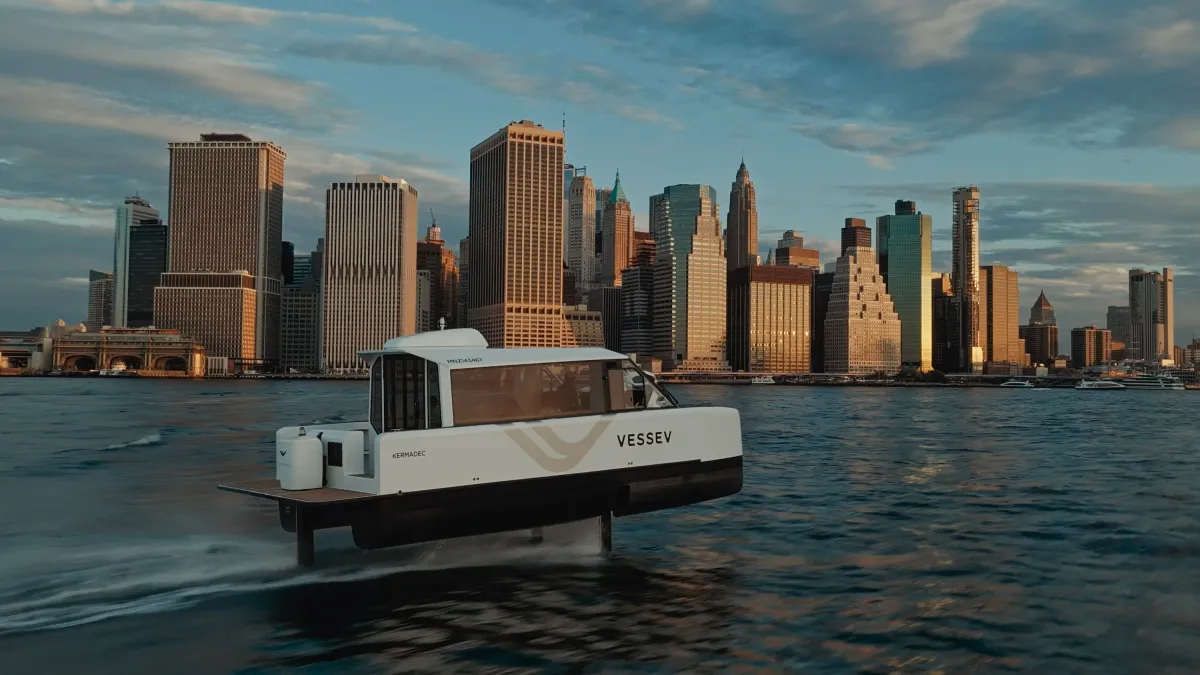
New Zealand startup Vessev is developing electric hydrofoil ferries that lift above the water to reduce drag, improve efficiency, and provide a smoother ride. The company believes the combination of hydrofoil technology and electric propulsion could lower operating costs for water transport while creating new options for urban transit, tourism, and private boating.
The company’s flagship vessel, the VS-9, recently demonstrated its capabilities on New York City’s East River, where it showcased a design that transitions from conventional sailing to hydrofoil operation with little noticeable change for passengers.
How The VS-9 Works
At first glance, the VS-9 resembles a conventional catamaran. Beneath the hull, however, are two wing-shaped hydrofoils that generate lift as the vessel gains speed.
Computer-controlled underwater flaps continuously adjust the foils to keep the ride stable and smooth. According to Vessev co-founder and CEO Eric Laakmann, roughly 80% of the lift comes from the front foil, while the rear foil provides the remaining 20%.
As the vessel accelerates, the foils raise the hull above the water’s surface. This reduces resistance and eliminates much of the bouncing and slapping commonly experienced by traditional boats traveling at higher speeds.
In-House Electric Propulsion
The rear foil also houses the electric motor, which Vessev designs and manufactures internally. Laakmann said the company chose to develop its own propulsion system rather than outsource production in an effort to control long-term costs.
The batteries are the main component Vessev does not manufacture itself. Laakmann noted that battery technology has become sufficiently standardized and widely available, making in-house production less necessary.
The VS-9 can be charged using standard electric vehicle charging infrastructure, simplifying deployment and operation.
Efficiency Benefits And Operational Limits
Hydrofoil technology has existed for more than a century, but its efficiency advantages have become increasingly relevant for electric vessels, where energy consumption directly affects range and operating costs.
By lifting the hull above the water, hydrofoils significantly reduce drag. The design also produces a smaller wake and a smoother ride for passengers.
However, hydrofoils are not suitable for every environment. The VS-9 performs best when wave heights remain below approximately 2.5 feet, or 0.75 meters. Larger waves can strike the hull, reducing efficiency and ride quality.
Because of these limitations, hydrofoils are generally better suited to rivers, lakes, bays, and protected waterways rather than open-ocean conditions.
Targeting Transit, Tourism, And Recreation
Vessev raised a $19 million Series A funding round in August and is initially targeting transit operators as customers.
Laakmann said electric hydrofoil ferries could supplement urban transportation networks by moving passengers across waterways without requiring significant new infrastructure. In cities such as New York, the vessels could potentially connect destinations in Brooklyn, Queens, and other waterfront areas.
The company is also pursuing opportunities with hotels and tourism operators. According to Laakmann, public demonstrations have additionally attracted interest from affluent individuals interested in recreational boating.
Future Expansion Plans
The VS-9 currently remains a one-of-a-kind vessel, but Vessev plans to manufacture additional units as it expands operations.
Looking further ahead, the company is considering producing electric hydrofoil kits that could allow third-party boatbuilders to design and construct vessels using Vessev’s technology platform.
The VS-9 is capable of carrying a full passenger load for up to 40 nautical miles, equivalent to approximately 46 miles or 74 kilometers.
Featured image credits: Vessev
For more stories like it, click the +Follow button at the top of this page to follow us.