

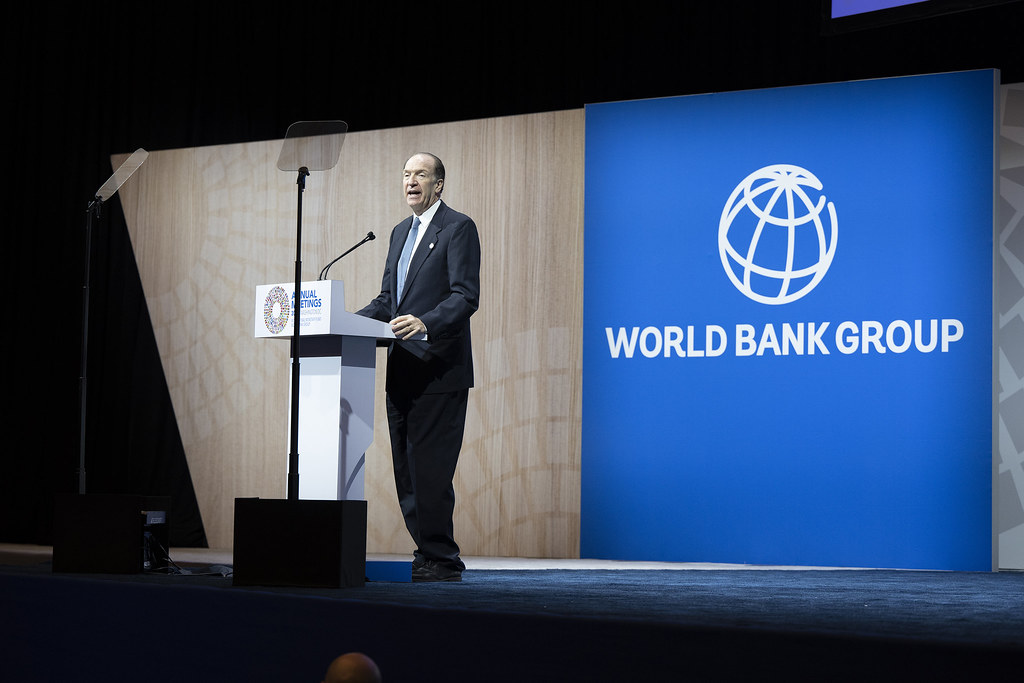
Former World Bank president David Malpass has urged China to reduce its stockpiling of food and fertiliser, arguing that the country could help ease growing global shortages linked to disruptions caused by the Iran conflict and the closure of the Strait of Hormuz.
Malpass made the comments during an interview with the BBC World Service’s World Business Report ahead of the Trump-Xi summit in Beijing.
“They have the biggest world stockpile of food stuffs and of fertiliser,” Malpass said.
“They can stop building their stockpiles,” he added.
The remarks come as governments worldwide attempt to secure fertiliser supplies ahead of spring planting seasons while shipping disruptions in the Strait of Hormuz continue affecting global trade routes.
China suspended exports of several fertiliser products in March, citing the need to preserve domestic supply.
The export restrictions followed earlier controls that had gradually expanded since 2021.
According to the report, China accounted for approximately 25% of global fertiliser production last year, with exports exceeding $13 billion.
Malpass Questions China’s Developing Nation Status
Malpass also challenged China’s continued classification as a developing country within international institutions.
“They present themselves as a developing country when they’re the second biggest economy in the world and in many ways rich,” he said.
“And yet they still have the pretence of being a developing country in the WTO and in the World Bank,” Malpass added.
He said China could voluntarily suspend that designation.
Malpass served as World Bank president from 2019 to 2023 and previously worked as Treasury Under Secretary for International Affairs under President Donald Trump between 2017 and 2019.
China rejected the criticism.
Liu Pengyu told the BBC in a statement that China remained committed to maintaining stability in global food and fertiliser markets.
“The root causes behind the current disruptions in global food and fertilizer supply chains are crystal clear; this blame cannot be shifted onto China,” Liu said.
Responding to comments regarding China’s developing-country status, Liu said China is “universally recognized as the largest developing country.”
“Upholding its status as a developing country is a legitimate right of China,” he added.
Hormuz Disruptions Continue To Pressure Global Markets
The Strait of Hormuz remains a major source of economic concern after disruptions linked to the Iran conflict affected energy and shipping markets.
Malpass argued that global powers should support efforts led by the United States to restore stability in the region.
“You can’t have a rogue state with plutonium, and you can’t block the Strait of Hormuz,” he said.
He also suggested China has strong economic incentives to support the reopening of shipping routes.
“China benefits from open waterways worldwide,” Malpass said.
“They run the shipping lines, own the containers, and make huge profit from trade with the rest of the world,” he added.
According to Malpass, China would suffer economically if Iran gained long-term control over the Strait of Hormuz.
Malpass Warns Prices May Continue Rising
Malpass also discussed the economic outlook in the United States ahead of upcoming inflation data.
He said he expected consumer prices to continue increasing.
“I expect some up, yes, prices will go up on many products,” he said.
At the same time, Malpass described recent US employment figures as “robust,” saying the labor market continued showing resilience despite geopolitical and economic pressures.
Featured image credits: GRANT ELLIS via Flickr
For more stories like it, click the +Follow button at the top of this page to follow us.