

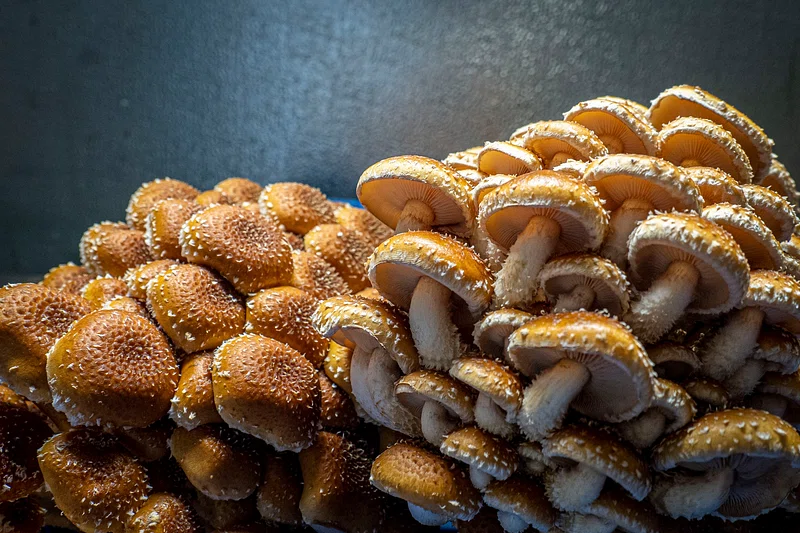
Alice Mushrooms, a mushroom-infused chocolate brand launched three years ago, is gaining traction in the United States with its sleep-focused chocolate product Nightcap, now sold in about 2,000 stores nationwide as consumer demand rises for snacks that claim to help people sleep better.
The product combines ingredients often associated with relaxation and sleep support. Nightcap chocolate contains reishi mushrooms and chamomile, both commonly linked with calming effects. It also includes magnesium and zinc, minerals believed to support the body’s natural production of melatonin, a hormone that regulates sleep.
Another ingredient in the formulation is L-theanine, an amino acid naturally found in green tea. The compound has gained attention in food products designed to promote relaxation.
Product Development And Ingredients
Alice Mushrooms co-founders Charlotte Cruze and Lindsay Goodstein developed the product after working with homeopathic doctors, PhD researchers, and professional product formulators.
“We probably took the longest time to formulate our sleep chocolate, of any of our products, because sleep is so tough,” said Cruze, who is based in New York City. “There’s a million different reasons that people can struggle with sleep.”
She said the company aimed to develop a product that could support different stages of the sleep cycle that might be disrupted.
Consumer Demand For Sleep Aids
The product’s expansion coincides with strong consumer interest in sleep aids. A survey conducted by mattress company Sleepopolis found that 47% of 1,003 Americans surveyed reported taking some type of sleep aid.
Natural supplements such as melatonin ranked as the most popular option, ahead of prescription and over-the-counter medications.
Sleep quality has also drawn attention in recent international research. IKEA’s 2025 Sleep Report ranked both the United States and the United Kingdom among the bottom 10 countries globally for overall sleep scores.
In the UK market, pharmaceutical sleep products remain the largest category. Natural remedies, however, represent the fastest-growing segment.
Emergence Of Sleep-Focused Snack Products
Products like Nightcap chocolate belong to a growing category often described as “sleep treats.” These products combine the wellness positioning of supplements with the format of snack foods.
Cruze said the snack format may help explain the category’s popularity. Eating chocolate before bed can feel like a reward, she said, while taking capsules can feel more medicinal.
Competition is increasing as other companies launch similar products. Goodnite sells dark chocolate sleep bites containing L-theanine and melatonin. Lagoon markets Night Bites that include L-theanine and magnesium. Good Day Chocolate offers a “Calm” range containing magnesium, L-theanine, and chamomile.
Reishi mushrooms also appear in chocolates, gummies, and drinks promoted for relaxation.
Scientific Evidence Behind Common Ingredients
Scientific evidence supporting some of these ingredients varies.
Research shows long-term benefits related to sleep for magnesium and melatonin. Evidence on chamomile indicates possible short-term improvements, though placebo effects often occur in studies.
Melatonin regulation differs across regions. In the United Kingdom, melatonin is available only through prescription. Doctors typically prescribe synthetic versions for short periods to treat sleep problems.
Studies on reishi mushrooms remain limited. Research conducted so far has been small and short-term, making statistical conclusions difficult.
L-theanine research also remains inconclusive. Japan approved the compound for use in foods in the 1960s because of its long association with green tea and matcha. The United States Food and Drug Administration approved it for use in food and beverages in 2005.
Regulations in Europe and the United Kingdom differ. L-theanine is permitted when naturally extracted from green tea but not when produced synthetically.
Melanie Stearns, assistant professor at the University of South Florida and director of the Family, Adolescent, Child, and Caregiver Translational Sleep Lab, said the dosage tested in scientific studies often exceeds the amount used in snack products.
“Because of this, the sleep benefits of L-theanine when consumed in products like chocolate or snack bars are not well studied, and their effects should not be expected to be dramatic,” Stearns said.
Concerns About Dosage And Ingredient Interactions
Researchers have also raised questions about cumulative exposure as sleep-related ingredients appear in more products.
Lina Begdache, research assistant professor at Binghamton University in New York who studies the relationship between food, mood, and sleep, warned about the risk of “dose stacking.”
“Evidence on chronic high consumption from fortified foods and long-term neurobehavioral outcomes is still sparse. Moderation, clear labelling, and attention to total daily exposure remain prudent,” Begdache said.
Sleep counsellor Dr Kat Lederle raised additional concerns about timing and ingredient interactions. Melatonin, for example, is usually recommended about two hours before bedtime. Alice Mushrooms states the effects of Nightcap chocolate may be felt within 15 to 45 minutes after consumption.
Lederle also questioned how compounds such as L-theanine behave when combined with food components such as fat, sugar, and protein.
“I’m wondering whether some of these claims are just too early,” said Lederle, who is based in London. “I think there’s still more research needed as to when and how much, in what composition, and the effect on different demographics.”
She also noted that snack-based sleep aids may lead some people to overlook lifestyle factors that affect sleep quality.
Cruze acknowledged that daily habits remain important.
“You could take four of our Nightcap chocolates, but if you’re staring at your phone and scrolling TikTok late at night, there’s no point,” she said.
Functional Food And Biohacking Trends
Interest in sleep snacks also reflects the wider rise of functional foods. These products combine food with targeted health claims.
Chef-turned-food consultant Amir Mousavi from Good Food Studio said entrepreneurs increasingly seek to develop brands in this category.
Mousavi previously helped develop fitness coach Joe Wicks’ Killer protein bar. The product served as a marketing stunt highlighting the ultra-processed nature of many health foods.
He said interest in functional foods connects with the trend known as biohacking, where people experiment with methods intended to improve physical or mental performance.
Mousavi described his own supplement routine, which includes creatine for muscle building, lion’s mane mushrooms for focus, ashwagandha for stress reduction, and reishi mushrooms in the evening for relaxation.
During a stressful period last year, he used a sleep aid containing L-theanine. He also purchased an AI-powered electric bed cover that adjusts temperature based on body heat to support sleep.
“We’re all bio-hacking like nobody’s business,” said London-based Mousavi. “It’s always been human nature. You want the cheat, you want the shortcuts.”
“People are very happy to experiment, even with just early stage scientific or proprietary evidence.”
Featured image credits: rawpixel.com / U.S. Department of Agriculture (Source)
For more stories like it, click the +Follow button at the top of this page to follow us.